How Are Stars Born, And How Do They Die?
Edition 2026-10
From a cloud of gas to a white dwarf, a neutron star or a black hole.
The short answer
A star is born when a cloud of gas and dust collapses under its own gravity until its center is hot enough to fuse hydrogen into helium. It shines for millions or billions of years, then, depending on how heavy it is, it either fades into a white dwarf or explodes as a supernova and leaves a neutron star or a black hole.
The Long Answer
Born In A Cloud
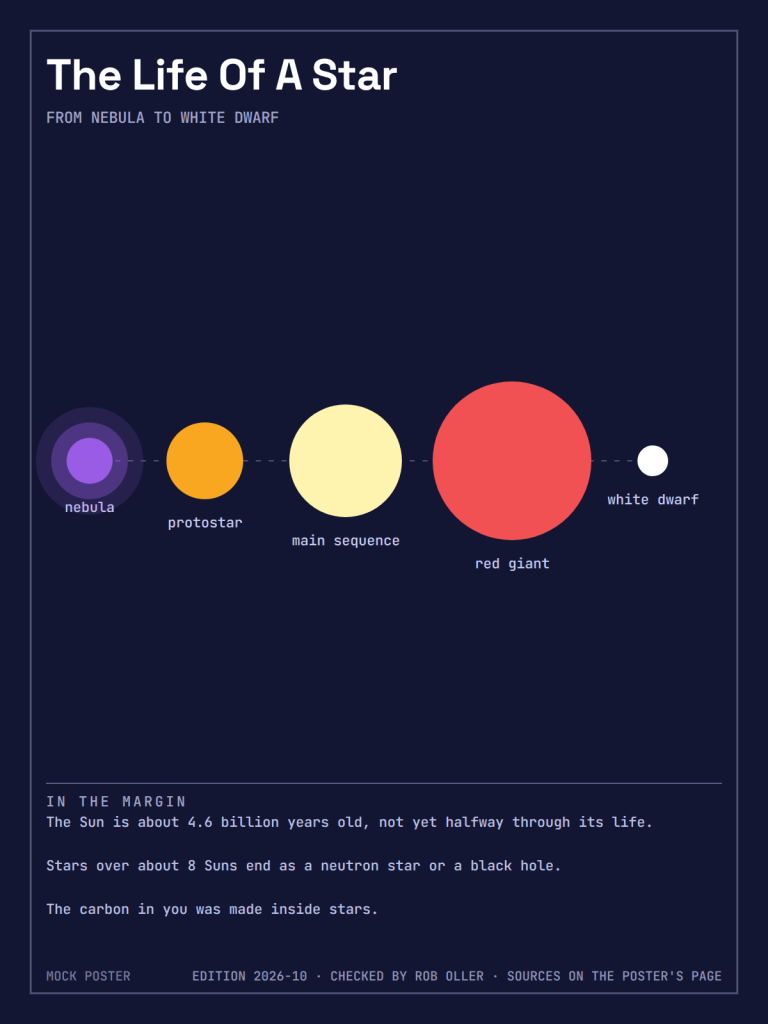
Stars form inside huge clouds of gas and dust called nebulae. A clump of the cloud starts to pull itself together, gets denser and hotter, and becomes a protostar. When the center passes 10 million degrees Celsius, hydrogen starts fusing into helium, and the star switches on.
A Long Middle
Most of a star's life is spent steadily fusing hydrogen. The Sun has been doing it for about 4.6 billion years and is a little less than halfway through. The heaviest stars burn so fast they last only a few million years; the smallest, red dwarfs, can last far longer than the universe has existed.
How It Ends
A star like the Sun swells into a red giant, puffs its outer layers into space, and leaves behind its hot core, a white dwarf about the size of Earth. A star born with more than about 8 times the Sun's mass ends in a supernova explosion. What is left is a neutron star, so dense that a sugar-cube-sized piece would weigh about a billion tons, or, for the heaviest stars, a black hole.
The explosions matter to you: the carbon in your body and the oxygen you breathe were made inside stars and spread through space when those stars died.
It is on the poster
Life Cycle Of A Star Poster
How a star is born, lives and dies.
$35 18x24$45 24x36
Reads alone from about 8
See the factsMore Questions
 On the Solar System poster
2026-10
What Is A Black Hole?
Not a hole at all: a lot of mass in a tiny space.
On the Solar System poster
2026-10
What Is A Black Hole?
Not a hole at all: a lot of mass in a tiny space.
 On the Black Hole poster
2026-10
What Is The Largest Cell?
An ostrich egg, or a seaweed you can hold. It depends on the question.
On the Black Hole poster
2026-10
What Is The Largest Cell?
An ostrich egg, or a seaweed you can hold. It depends on the question.
 On the Cell poster