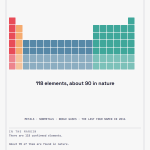
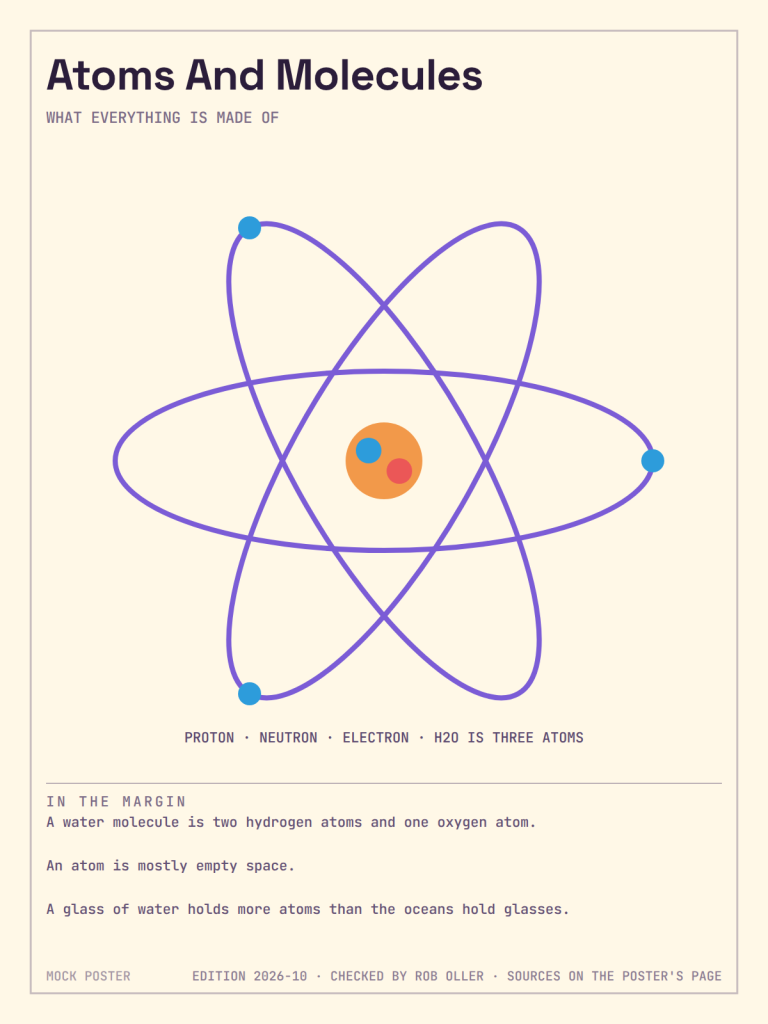
The periodic table, drawn so a kid can read it.
All 118 elements, each with a picture of where it shows up in real life, and how the table got its shape.
Reads alone from about 9; a parent reads the margin aloud before that.
Prints in 2 to 5 business days, then 3 to 4 to your door. Shipping is $4.99 for an 18x24 and $7.99 for a 24x36, plus 40 cents for each poster after the first. US addresses only.
Checked by Rob Oller Edition 2026-10 Sources listed below
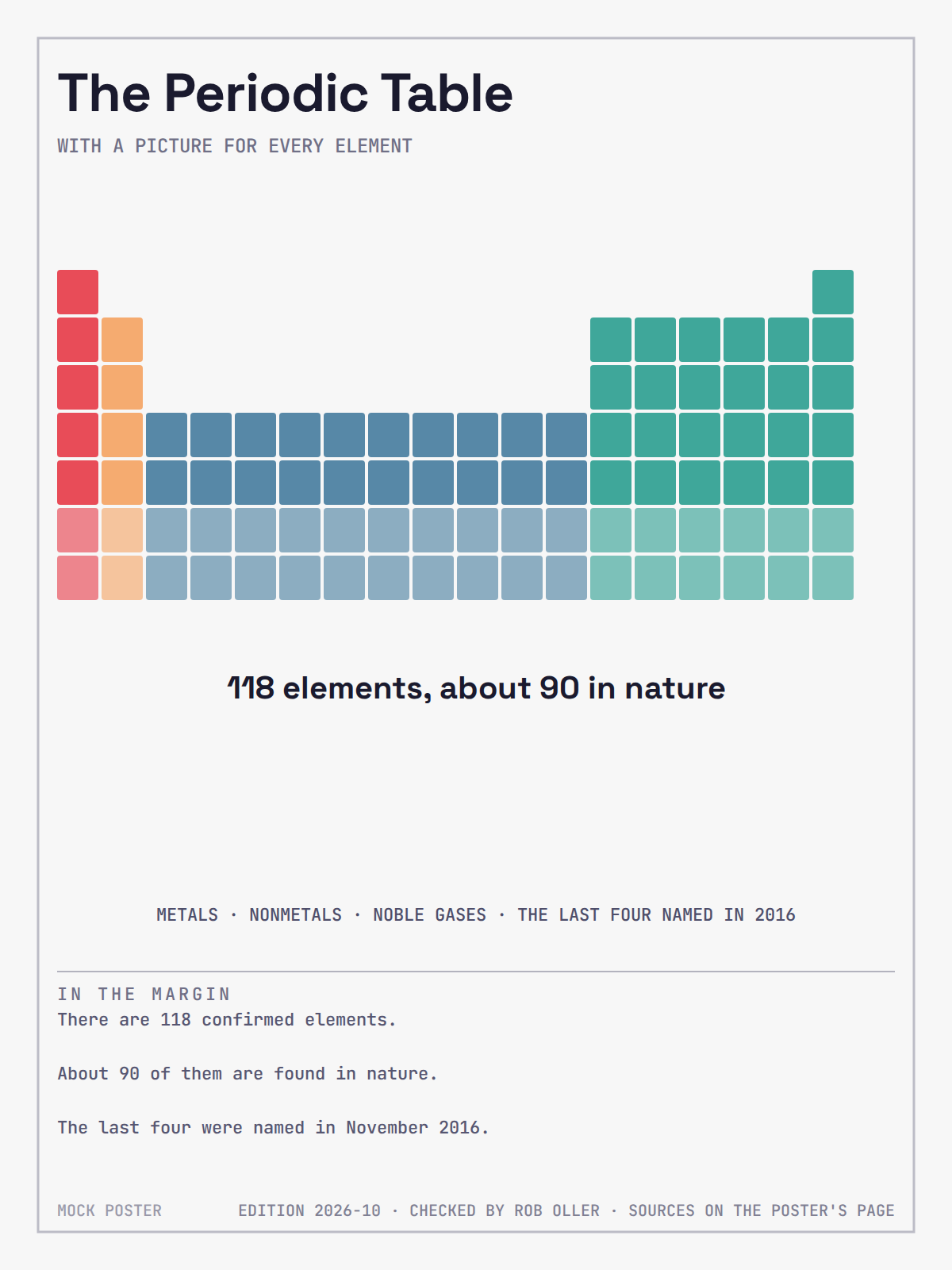
in-frameThe poster in its 18x24 frame on a painted wall, straight on, whole frame in shot.
child-heightThe poster on a kid's bedroom wall, shot from a seven-year-old's eye height, a kid reading it.
margin-close-upThe margin facts, close, sharp enough to read, to show the type size and the paper.
unboxingThe kraft box as it arrives, and the rolled poster coming out of it.
What Is On This Poster
8 factsThe facts this poster carries, so you can match it to what your kid is asking about before you buy.
- There are 118 confirmed elements.
- About 90 of them are found in nature; the rest have been made in laboratories.
- The last four were named in November 2016: nihonium (113), moscovium (115), tennessine (117) and oganesson (118).
- Dmitri Mendeleev published his periodic table in 1869 and left gaps for elements nobody had found yet.
- Hydrogen is the most common element in the universe.
- Oxygen is the most common element in Earth's crust, about 46 percent by mass.
- Only two elements are liquid at room temperature: mercury and bromine.
- Oxygen makes up about 60 to 65 percent of your body's weight, more than any other element.
Sources
- IUPAC: names of elements 113, 115, 117 and 118
- LibreTexts Chemistry: the elements
- Royal Society of Chemistry: Gallium
- NASA Science: glossary
- USGS Circular 285: elements of the Earth's crust
- Royal Society of Chemistry: Mercury
- Royal Society of Chemistry: Bromine
- Guinness World Records: most common element in the body
- ICRP Reference Man: elements in the body
Every source for every poster, and every correction, is on the sources and corrections page.
Fits These Frames
in-frame-18x24The sample 18x24 in a standard 18x24 frame from a big-box store, the frame's brand visible on the back.
18 x 24 Inches
Fits a standard 18x24 frame, the usual size for art prints, sold at big-box stores.
Printed sizes can run a little over, so the design keeps everything that matters clear of the edge and the frame hides nothing.
in-frame-24x36The sample 24x36 in a standard 24x36 poster frame, on a wall, with a door or chair for scale.
24 x 36 Inches
The most common poster size in the US, and the one budget frames are made for. Readable from across a room.
The same margin rule: nothing important sits near the edge.
189 gsm Matte Paper
Thick, smooth and glare-free. Printful, who prints it, calls it museum-quality paper.
Epson UltraChrome GS3
Pigment ink Printful lists as GREENGUARD Gold certified. Deep blacks, which a night sky needs.
Rolled In A Kraft Box
No plastic caps. Unroll it face up, lay a clean sheet of paper on it with a few books on top, and give it a night. Damaged on arrival, we send another.