What Are The Kingdoms Of Life? How Scientists Sort Living Things
Edition 2026-10
Five kingdoms, six, or three domains? How scientists sort every living thing.
The short answer
Scientists sort every living thing into groups inside groups. Many schools teach five or six kingdoms: animals, plants, fungi, protists, and one or two kingdoms of tiny cells with no nucleus. Above the kingdoms, most biologists now use three domains: Bacteria, Archaea and Eukarya.
The Long Answer
Sorting living things is called taxonomy. The groups nest like boxes inside boxes, from the biggest to the smallest:
- Domain
- Kingdom
- Phylum
- Class
- Order
- Family
- Genus
- Species
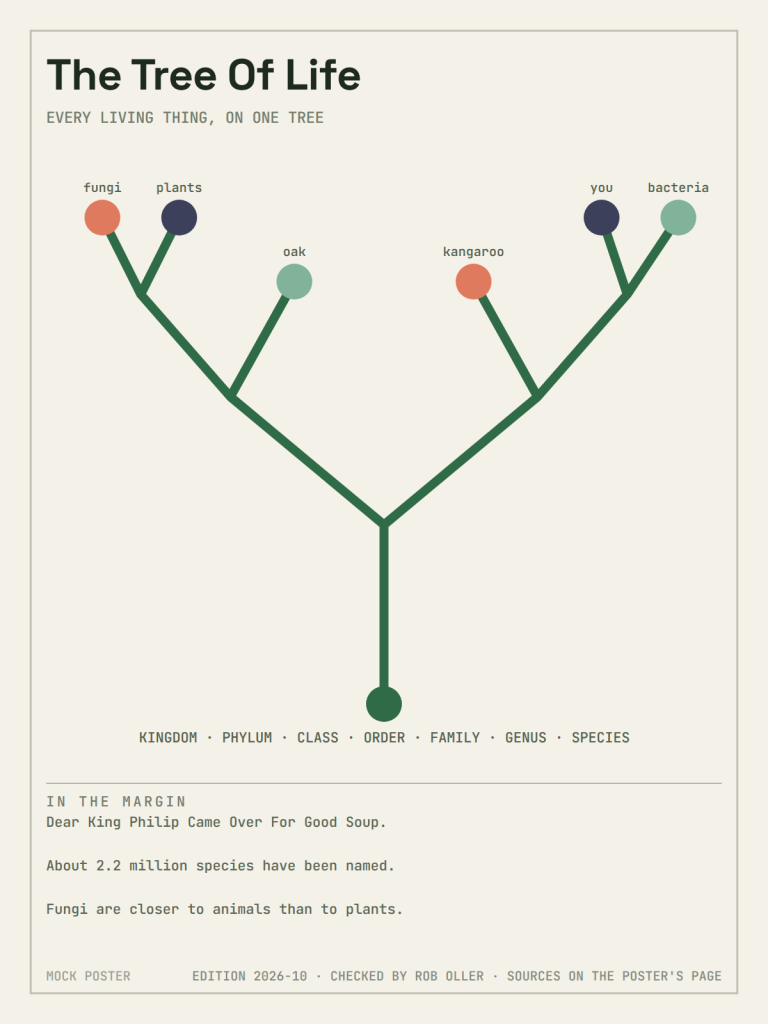
A sentence to remember the order: Dear King Philip Came Over For Good Soup.
Where The Kingdoms Came From
In 1969 the ecologist Robert Whittaker proposed five kingdoms: Monera (bacteria), Protista, Fungi, Plantae and Animalia. Many classrooms later split Monera in two, bacteria and archaea, which makes six. In 1990 Carl Woese and colleagues proposed putting three domains above all the kingdoms, because archaea turned out to be as different from bacteria as bacteria are from us.
You, A Kangaroo And An Oak Tree
You are Homo sapiens: domain Eukarya, kingdom Animalia, phylum Chordata, class Mammalia, order Primates, family Hominidae, genus Homo. A red kangaroo is with you all the way down to class Mammalia, then splits off into its own order, Diprotodontia. An oak tree, genus Quercus, shares your domain but parts ways at the kingdom: it is a plant. And a mushroom is closer to you than to the oak, because fungi are more closely related to animals than to plants.
Sources
- Woese, Kandler and Wheelis 1990, three domains (PNAS)
- Whittaker 1969, five kingdoms (Science)
- Encyclopaedia Britannica: taxonomy
- IUCN Red List described species, via Our World in Data
- Mora et al. 2011, how many species are there?
- The Linnean Society: naming nature
- Australian Museum record: red kangaroo
- Baldauf and Palmer 1993, animals and fungi
It is on the poster
Tree Of Life Poster
Every living thing, on one tree.
$35 18x24$45 24x36
Reads alone from about 8
See the factsMore Questions
 On the Solar System poster
2026-10
What Is A Black Hole?
Not a hole at all: a lot of mass in a tiny space.
On the Solar System poster
2026-10
What Is A Black Hole?
Not a hole at all: a lot of mass in a tiny space.
 On the Black Hole poster
2026-10
How Are Stars Born?
From a cloud of gas to a white dwarf, a neutron star or a black hole.
On the Black Hole poster
2026-10
How Are Stars Born?
From a cloud of gas to a white dwarf, a neutron star or a black hole.
 On the Life Cycle Of A Star poster