How Does The Eye Work? Explained For Kids
Edition 2026-10
Light in, upside-down picture, brain sorts it out.
The short answer
Light comes in through the clear front of your eye, the lens focuses it onto the retina at the back, and the retina turns it into signals that travel down the optic nerve to your brain, which builds the picture you see.
The Long Answer
Light passes through the cornea, the clear window at the front, and then the pupil, the black hole in the middle of the colored iris. The iris makes the pupil smaller in bright light and bigger in the dark.
Behind the pupil, the lens bends the light so it lands in focus on the retina, a thin layer at the back of the eye. The picture that lands there is upside down; your brain turns it the right way up.
The retina has two kinds of light-catching cells. About 100 million rods work in dim light and see in shades of gray. About 5 million cones see color and fine detail.
The signals leave each eye through the optic nerve, a cable of more than a million nerve fibers. Where the nerve leaves the retina there are no rods or cones at all, so each eye has a small blind spot. You never notice it, because your brain fills it in.
Sources
- National Eye Institute: How the eyes work
- American Academy of Ophthalmology: images on the retina
- Curcio et al. 1990, rods and cones counted
- The optic nerve (PMC)
- American Academy of Ophthalmology: the blind spot
- NIAMS (NIH): learning about bones
- Cleveland Clinic: how many bones does a baby have?
- Cleveland Clinic: fun facts about your heart
- Hatton et al. 2023, the human cell count (PNAS)
- StatPearls: blood volume
- Stapes dimensions (CT study)
- MedlinePlus: the skin
- Cleveland Clinic: Femur
- OpenStax Anatomy and Physiology: organ systems
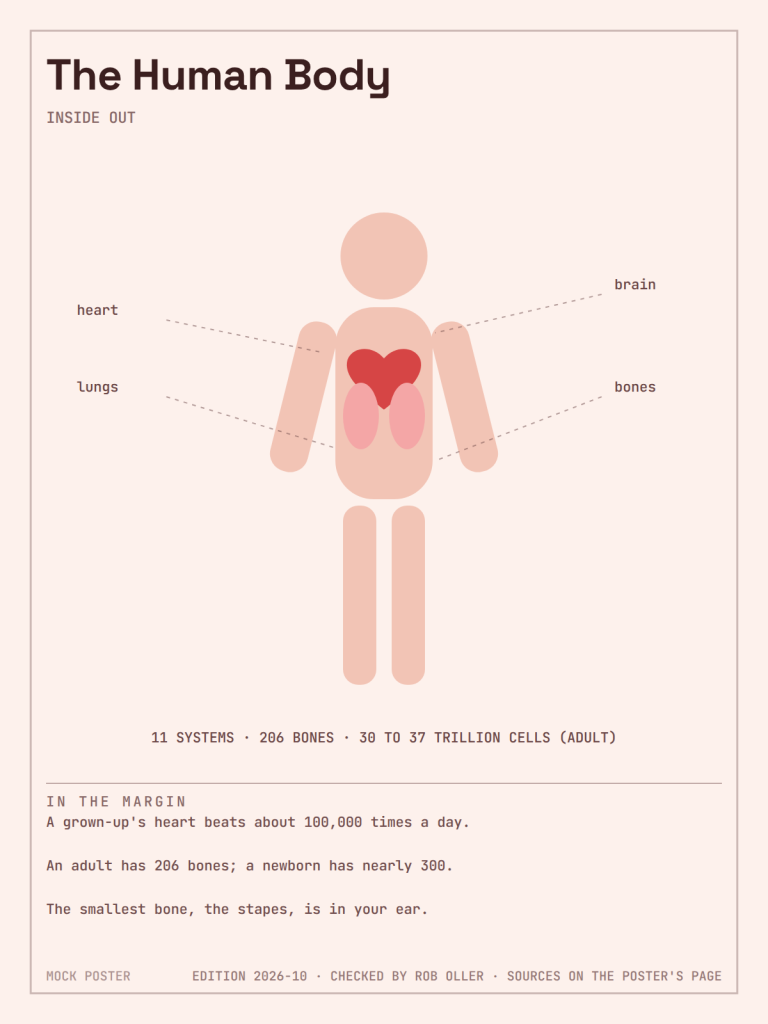
It is on the poster
Human Body Poster
The body, inside out.
$35 18x24$45 24x36
Reads alone from about 7
See the factsMore Questions
 On the Solar System poster
2026-10
What Is A Black Hole?
Not a hole at all: a lot of mass in a tiny space.
On the Solar System poster
2026-10
What Is A Black Hole?
Not a hole at all: a lot of mass in a tiny space.
 On the Black Hole poster
2026-10
How Are Stars Born?
From a cloud of gas to a white dwarf, a neutron star or a black hole.
On the Black Hole poster
2026-10
How Are Stars Born?
From a cloud of gas to a white dwarf, a neutron star or a black hole.
 On the Life Cycle Of A Star poster